
Coral Gold Cup 2026 Trends: How The 17 Declared Runners Measure Up Against The Stat That Beats The Betting

We tested 39 Coral Gold Cup trends against the betting before Saturday's race at Newbury. Most of the ones you will read this week tell you nothing the prices don't already know, but one about where the winner sits through the race stood up to everything we threw at it.
Every big handicap comes with a list of trends and the Coral Gold Cup, run at Newbury at 3.00 on Saturday, has a longer list than most. The winner is usually aged six to eight, usually near the front of the betting and often in a second season over fences, or so every preview will tell you between now and the weekend.
What those lists never tell you is whether the trend knows anything the betting doesn't. A stat can be true in eight years out of ten and still be worthless if the bookmakers had it covered all along, so we have gone back through the last ten runnings, and through every long-distance handicap chase at Newbury since 2016, and measured each trend against what the starting prices said should happen.
The trends come first, with the winners behind them, and the test follows further down. Scroll to the foot of the page and you will find a grid showing how all 17 declared runners measure up.
The Trends You Will Read Everywhere
The race has been the Hennessy, the Ladbrokes Trophy and the Coral Gold Cup inside the last ten years, and its winners have run from a future Cheltenham Gold Cup winner in Native River to a 33/1 shot in Cloudy Glen, who had not seen a racecourse for 231 days.
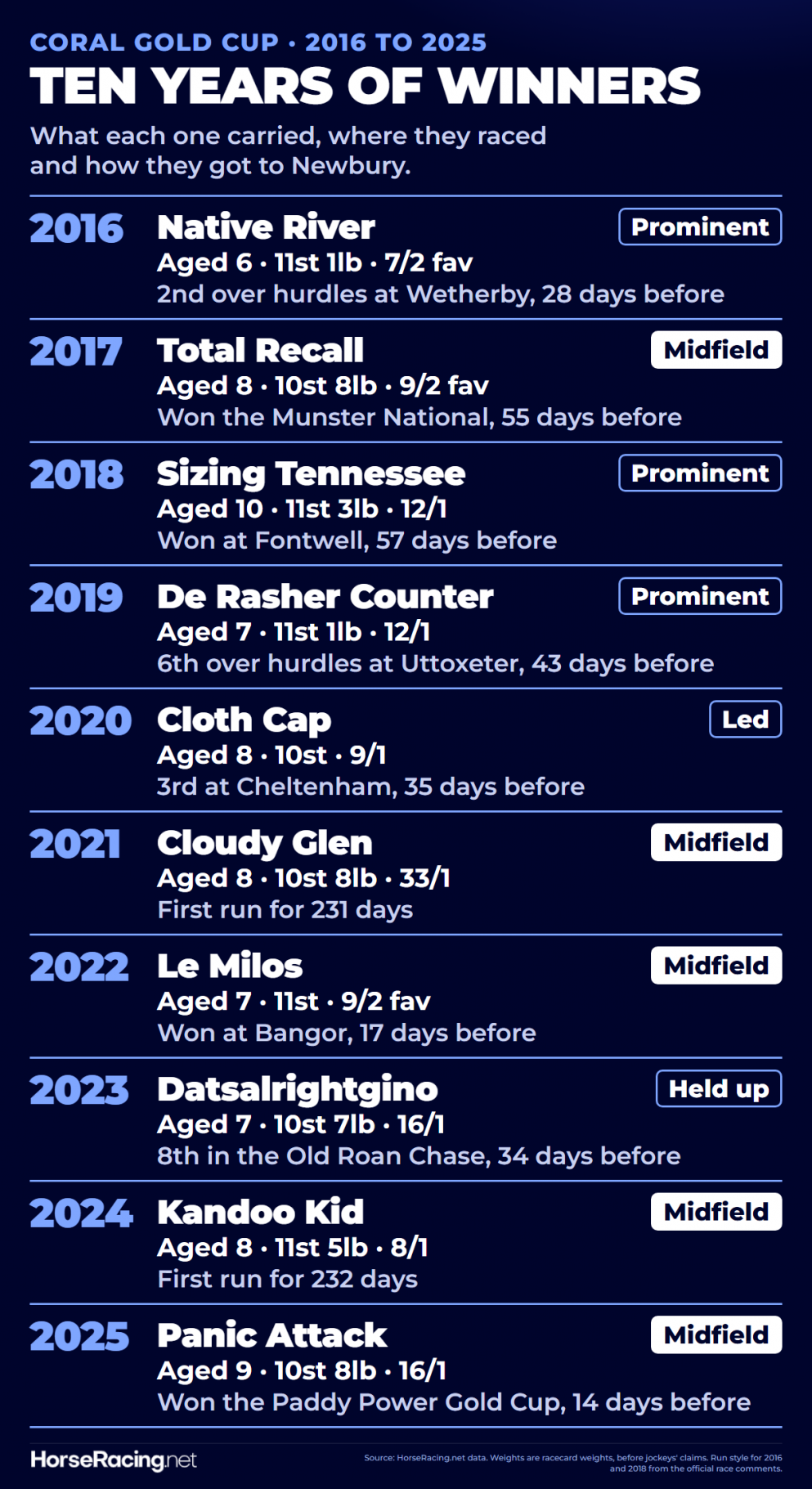
Go through those ten and the same handful of patterns turn up, and these are the five you will see quoted most often this week.
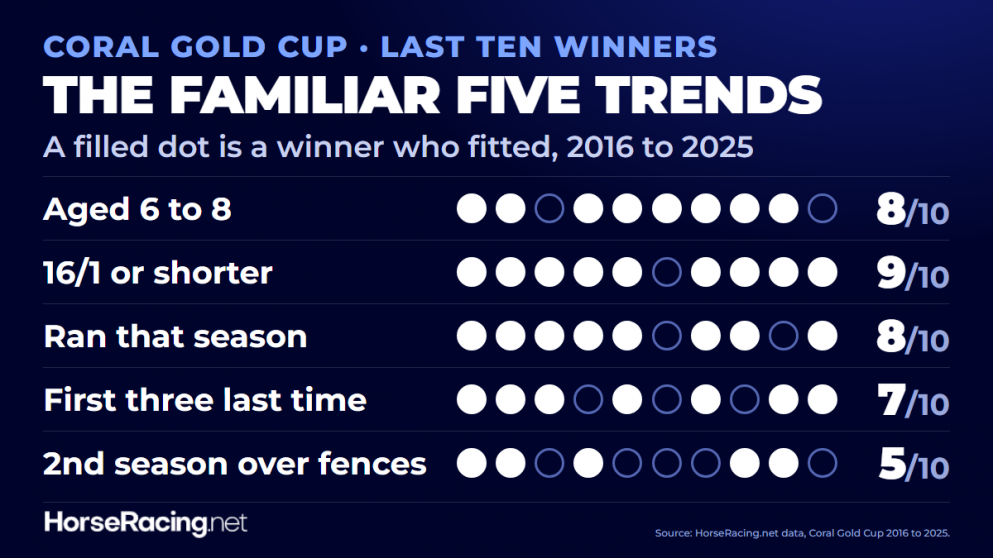
Putting Them Up Against The Betting
For every runner in the last ten runnings we took the starting price, stripped out the bookmakers' margin and turned what was left into a chance of winning. Add those chances up for, say, every runner aged six to eight and you have the number of winners the betting expected from that group. If the group won about that many, the trend has told you nothing you could not have read off the odds.
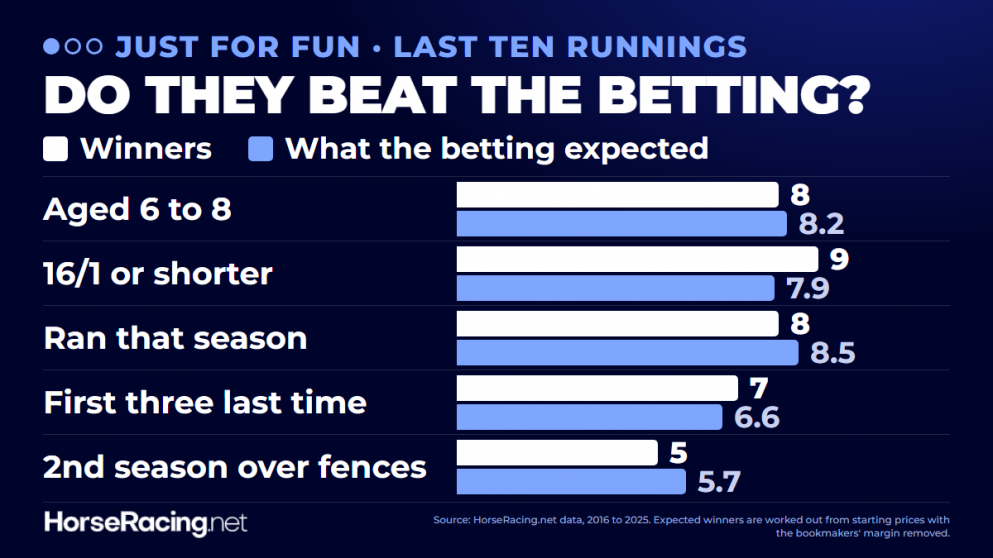
So all five are true, and all five are fine to quote in the pub, but none of them will find you an edge and we have rated them "just for fun". The same went for most of the other angles we tried. Last-time-out winners, previous course winners, Irish-trained runners, horses prepped over hurdles and the big yards all came out close to par.
The one market angle worth a line concerns the outsiders. In Newbury handicap chases with 12 or more runners since 2016, horses sent off at 20/1 or bigger have won just one of 179 when the betting expected four or five, although in the Coral Gold Cup itself they have filled 11 first-four places against an expected 8.6, so they hit the frame far more readily than they win.
Why It Pays To Sit In Midfield
Only one trend came through with a rating of "strong", and it has nothing to do with age or form figures. In the 29 handicap chases over three miles or further at Newbury since the 2016-17 season, horses ridden in midfield have won more than twice as often as their prices said they should. A gap that size turns up by luck about once in a thousand times, and it is still there when you take the Coral Gold Cup out and look at the other 20 races on their own.
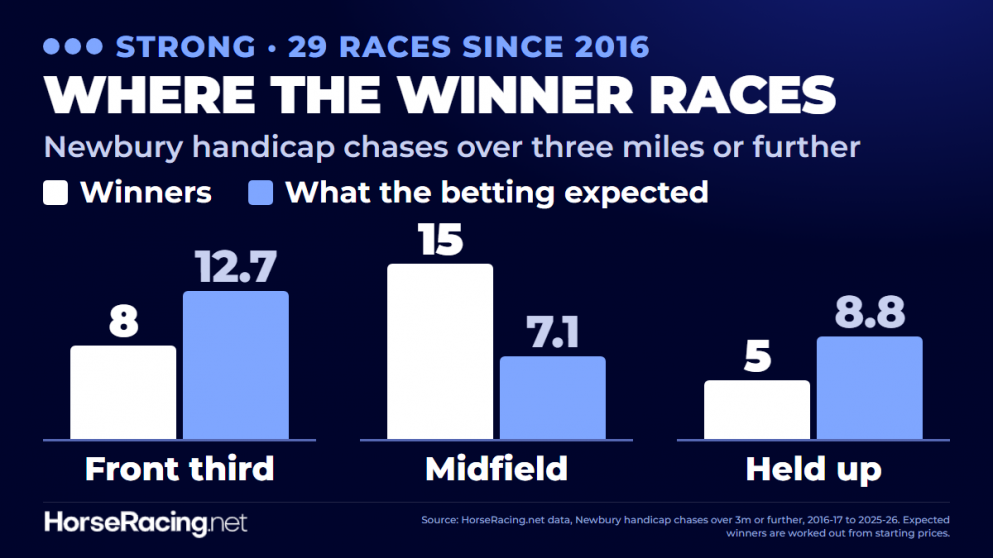
That is the opposite of what we found at Cheltenham earlier this month, where it paid to be on the pace. Across every chase at Newbury since 2016 it still pays to be handy, with the front third winning 164 races against an expected 148, and the picture only flips in the long handicaps. In the Coral Gold Cup itself, five of the nine winners from 2017 to 2025 came from midfield against an expected 2.6, which points the same way but is too small a sample to prove anything by itself.
The catch is that this describes where the winner raced on the day, and nobody knows for certain where a horse will be ridden until the tapes go up. That is why it cannot put a line through any runner. What we can do is project where each of them is likely to sit from the way they have been ridden lately, and that is what the pace map does.
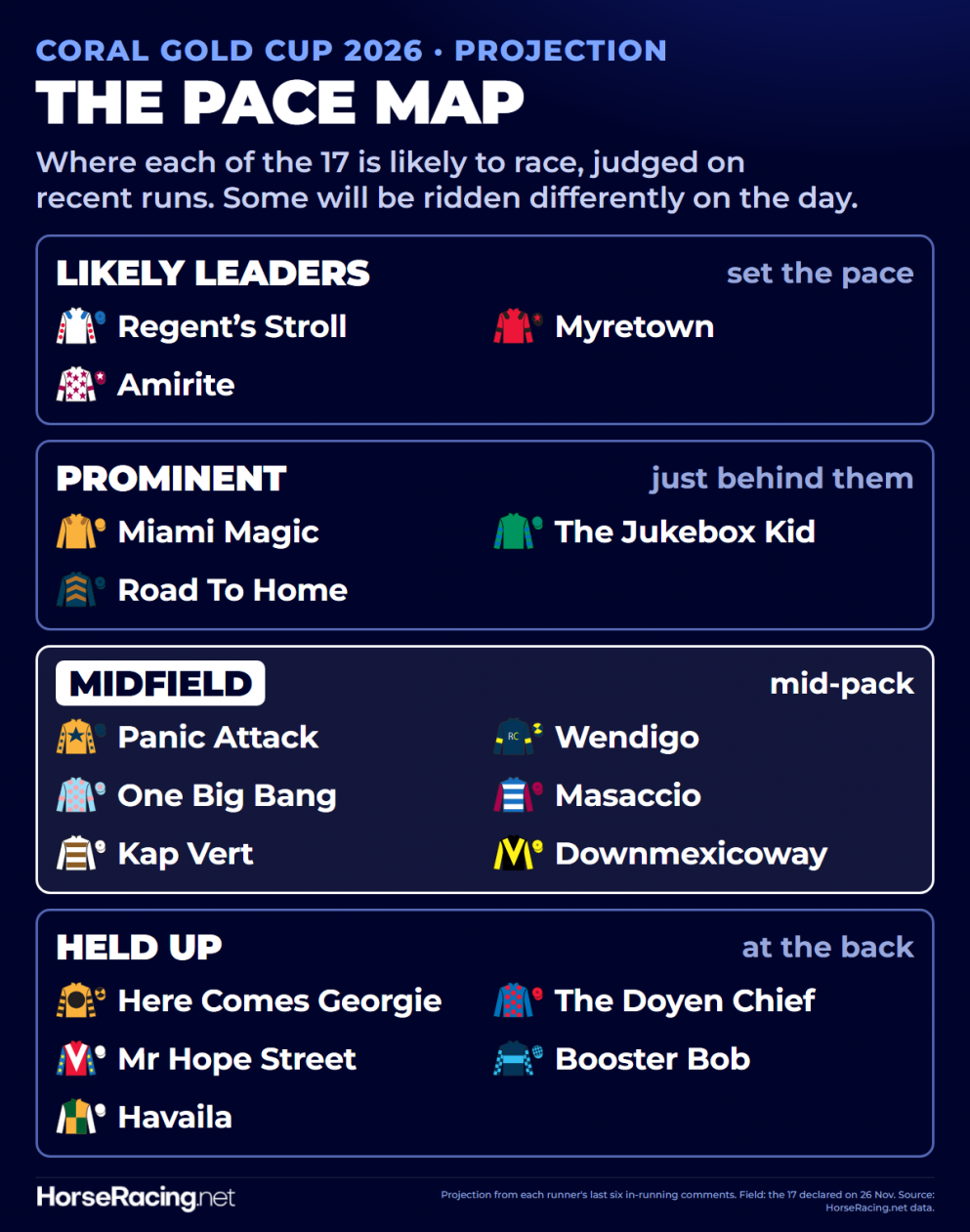
Regent's Stroll, Myretown and Amirite look the likeliest to take them along, and with three more who like to race close up there should be no hanging about. That is the sort of race that sets up for something sat just off the pace. Six of the 17 project as midfield runners, the favourite Wendigo and last year's winner Panic Attack among them, although Wendigo helped force the pace in a three-runner race at Carlisle last time and could easily be ridden closer than that.
Big Weights And The Favourite
No horse has won this race carrying 11st 7lb or more since at least 2010. The betting expected three or four of them to win in that time, and the chance of none doing so by luck is about one in 25.
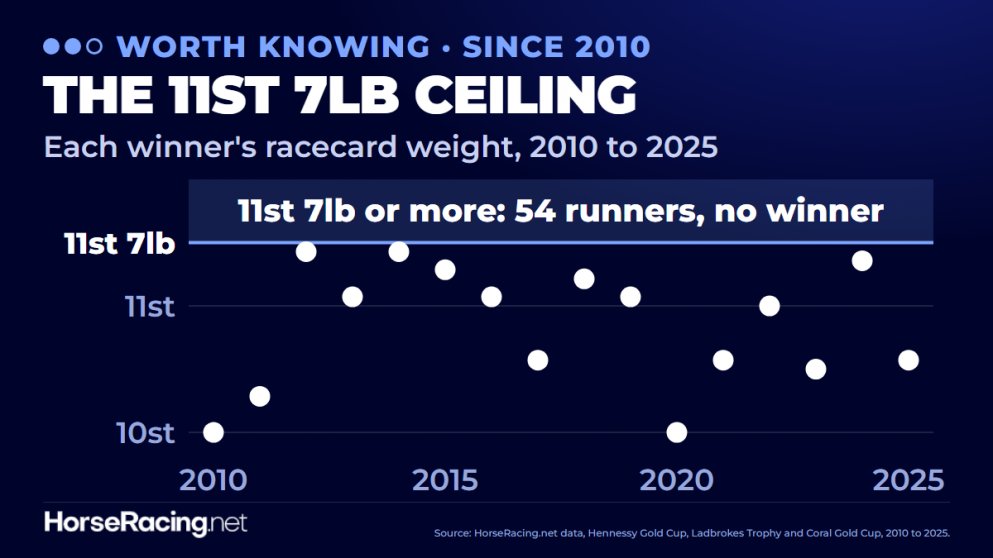
The class horses still run well under those weights. Six of them have finished second since 2010, and in the last ten runnings they have filled nine first-four places, which is almost exactly what their prices predicted. What they have not managed is to get their head in front, and the obvious explanation is that giving weight away to an improving second-season chaser over three and a quarter miles is about as hard as this game gets.
We have rated it "worth knowing" and no higher, for three reasons. Denman won this twice under 11st 12lb before our data starts, in 2007 and 2009. In Newbury's other long handicap chases the big weights win about as often as their prices say they should, with 23 winners against an expected 26.6 since 2010. And the weights went up by 2lb in 2022, when the top weight became 12st, so 11st 7lb is a rung lower on the ladder than it was in Bobs Worth's day.
It matters more than it did on Tuesday. The top weight came out at Thursday's declarations, which pushed the weights up 5lb, so eight of the 17 now carry 11st 7lb or more, the first two in the betting among them. The favourite has gone from sitting exactly on the line to carrying 5lb over it. Nothing in this piece rules any horse out and that goes for him too, but at 4/1 it is one more thing he has to overcome.
How The Field Measures Up
The grid below takes the three trends we rated "worth knowing" and sets them against the 17 declared runners. The familiar five are left off it, because we have just seen they tell you nothing the betting doesn't.
Thursday's declarations changed it more than three absentees would suggest. With the top weight out, everything went up 5lb and four more horses crossed 11st 7lb. The prices can still move either side of 16/1 before the off, so we will update the grid again on Saturday morning for any non-runners. Take this version as the picture on Thursday.
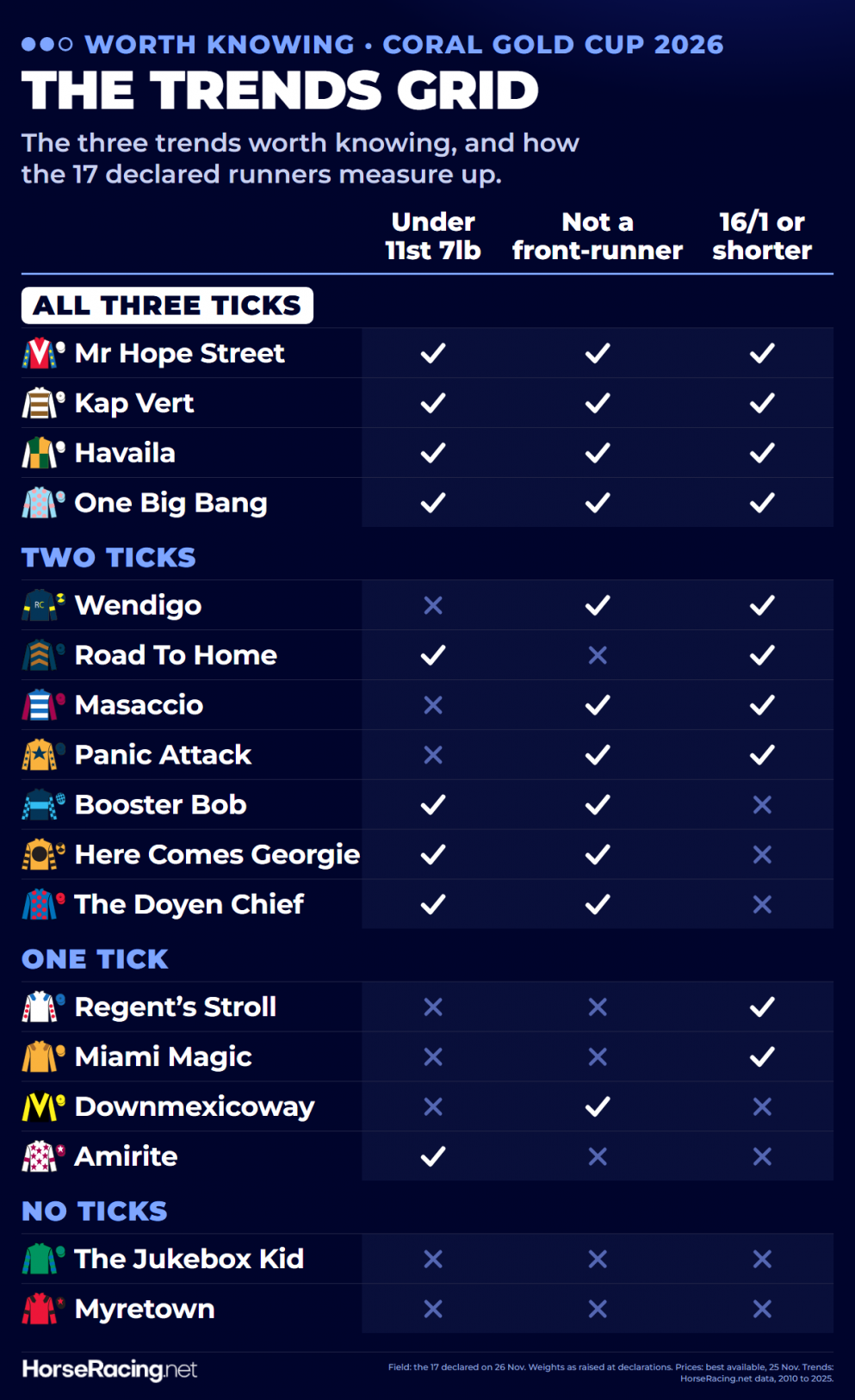
Four horses tick all three boxes in Mr Hope Street, Kap Vert, Havaila and One Big Bang, and of those Kap Vert (10/1) and One Big Bang (16/1) are the best fits in the field. They are the two usually ridden in midfield, which is where Newbury's long handicaps are won, and One Big Bang has joined the group by shortening from 25/1 since Tuesday. Mr Hope Street (7/1) and Havaila (10/1) both come from the back. Only five of those 29 winners were held up, so each of them needs the leaders to go too hard and a clear run through a big field.
The favourite Wendigo (4/1) still has two ticks, but the rise in the weights has made his cross a bigger one. He now has 11st 12lb, 5lb over a line no winner has crossed since at least 2010, although when he has run in bigger fields he has been ridden in midfield. Regent's Stroll (6/1) is the one at the head of the betting the trends like least. He goes to the top of the weights on 12st and has led or disputed the lead in five of his last six starts, which leaves him with a single tick.
Road To Home (8/1) is the shortest price of the rest with two ticks, his one cross for racing close to the pace. The rise in the weights pushed last year's winner Panic Attack and Miami Magic over the line, and it left The Jukebox Kid and Myretown on exactly 11st 7lb, which makes them the only two runners without a tick. You can see which box everyone else is missing on the grid.
How we tested: 39 angles on the race from its last ten runnings, 2016 to 2025, with weight going back to 2010, plus run style, weight and the market across Newbury's other chases since 2016, all from HorseRacing.net's results data. Each was measured against the number of winners the starting prices predicted. A trend rated "strong" had to show a gap that luck produces less than once in 20, repeat in a second set of races and have a racing reason behind it. "Worth knowing" means a clear gap with a reason behind it but not enough evidence to lean on, and "just for fun" means the winners were in line with the prices.
