
Best Lay Betting Sites in the UK (2026)
Lay betting sites allow you to play the role of the bookmaker by betting on things you think won’t happen, as well as playing the traditional punter and betting on things you think will happen.
Lay betting sites, also known as betting exchanges, let you bet against other customers rather than the ‘house’.
This guide reviews the top UKGC-licensed lay betting sites, focusing on commission, liquidity, payout speeds, and advanced features. The guide is as useful for beginners who are new to all this as it is for more sophisticated exchange users looking to take things to the next level.
Our Top 2 UK Lay Betting Sites for 2026: At-a-Glance Comparison
Let’s start by addressing the elephant in the room. Though above we call them the Top 2 lay betting sites in the UK, in reality, they’re the only lay betting sites UK, so you can see why we’ve only listed two of them!
But they’re both licensed by the UKCG, so they’re certainly legal and safe, and they’re also all sites we personally endorse, or else we wouldn’t be talking about them to begin with.
To give you further insight, we’ve included key information in the table below and gone into a little more detail in our mini-reviews of each one.
| Rank | Exchange | Best For | Commission Model | Liquidity Rating | Tested Payout Speed | Unique Lay Betting USP |
|---|---|---|---|---|---|---|
| 1 | Betfair | Pretty much everything. They’re the market leaders according to most metrics. | 5% as a default for UK customers; in some cases commission paid can be less, or more, than 5%. | 9/5/10 | 1-5 Business Days. | More markets and liquidity than anywhere else. |
| 2 | Matchbook | Paying less commission on winning bets. | 2% for UK users; 4% for the rest of the world. | 8.5 | 1 hour in some cases, but sometimes up to 3 days. | A lower standard commission than at other Exchanges while boasting excellent liquidity. |
Betfair
It was the arrival of Betfair that led to punters realising there was another way of doing things when it came to betting on sport, which ultimately led to fixed-odds bookmakers having to up their game; so sports bettors in the UK have the Betfair betting exchange UK to thank for what it did.
But back to the Betfair Exchange itself. At the time of writing, there were 28 different sports on which you could take part in back and lay betting, ranging from the obvious ones like football, horse racing, tennis,and cricket, to the far less obvious ones like handball, chess and mixed martial arts.
What shouldn’t also be underestimated is what an excellent and insightful barometer of public opinion they are as regards politics markets such as general elections and ‘Next US President’ markets, awards such as the Oscars and BBC Sports Personality of the Year, and reality TV shows like X-Factor and I’m a Celebrity Get Me Out of Here.
When it comes to the biggest sports like football, cricket, American Football and horse racing they don’t just offer the most obvious markets like the winner market, they also offer plenty more. Sure, not as many as you’d find on their impressive Sportsbook but more than enough to meet most punters’ needs.
But probably the key reason why Betfair is such a brilliant tool for serious bettors lies in its liquidity.
It has over 4 million customers worldwide and though it’s not easy to know for sure how many are active on the Exchange, what we do know is that it processes over 7 million transactions a day.
On the subject of betting exchange commission, the default rate is 5% for UK customers, and 7% for customers in most other countries, but users who are extremely active on the Exchange and pump lots of money into it, can get considerable discounts (as much as 60% for the heaviest of users) as a reward.
Betfair exchange customers can also choose to pay just 2% commission instead and not benefit from being on their Rewards plan, meaning they miss out on such benefits as free bets or the right to take part in certain promos, while those choosing to pay more commission (9%) get better rewards but…obviously pay more commission on all winning bets.
But yes, let’s not mess around: this is by far the best all-round lay betting site in the world.
Pros & Cons of Using Betfair
Positives
- Excellent liquidity means higher odds and more money waiting to be matched.
- Close to 30 different sports to bet on.
- Pick and choose whether to use their Sportsbook or Exchange as you wish.
Negatives
- £30 minimum deposit for most e-wallets is quite high.
MatchBook
Given what we’ve just said about Betfair it may seem that Matchbook is always going to pale into comparison when it comes to it as a lay betting site, but that’s not always necessarily the case.
For starters, they tend to charge less commission so the vast majority of punters will be paying 2% to 3,% which is a fair bit less than most pay over at Betfair.
Furthermore, Matchbook’s fee structure tends to be less complex and more transparent. There are usually fewer tiers or hidden premium charges, making it easier to calculate your net profits without unexpected fees - particularly important for winning customers or matched bettors analysing ROI.
However, they don’t have as many sports to bet on as Betfair do, but they do have all the main ones, so assuming you like to play the most popular sports - racing, football, tennis etc - you should be able to find those sports here, too.
There’s also something to be said for the Matchbook interface, in many ways cleaner and easier to use than Betfair, whose legacy platform can at times look a bit dated.
You can also place Exchange Bet Builders here, so those who like to do so at Sportsbooks can do exactly the same thing here.
But for the value-conscious punter who doesn’t want to incur too many fees, this is the smart choice as the top lay betting site where you pay the least commission at.
Pros & Cons of Using MatchBook
Positives
- Less commission is paid here than at Betfair in most cases.
- Simple commission structure means customers know what the deal is regarding how much they’re paying in commission.
- Bet Builders are available as Exchange bets.
Negatives
- Don’t offer betting on some of the more niche sports.
#AD 18+ New Customers Only. Sign up using Bonus Code: COMMFREE110. Pay 0% commission on all sports bets for your first 110 days. Users making their first deposit by Skrill, Neteller or PaySafe card will not qualify for this promotion. T&Cs Apply. Be Gamble Aware.
Lay Betting Explained: Playing the Bookmaker
We’ve talked about laying bets in passing, but now is the time to talk about how to lay a bet, what that actually means, and why it’s a great betting option for many punters. Read on because this section is all about lay betting explained.
Back vs. Lay: The Fundamental Difference
When you put money on Manchester United to beat Everton at 2.0, you’re backing a bet by saying Man Utd will win. The bookmaker is laying the bet to you at those odds. If you backed the horse Black Beauty, the bookmaker is laying a bet on that horse to win, while you’re backing it.
So to put it in the simplest terms, laying a bet is playing the role of the bookmaker, backing a bet is playing the role of the punter. Of course, at lay betting sites, you can do both as a customer.
Understanding Liability: Your Role as the Bookmaker
In normal circumstances as a punter, it’s all pretty straightforward when it comes to your liability: it’s whatever your stake is.
So a £5 bet on Carlos Alcaraz to beat Jannik Sinner means your liability is £5 irrespective of what odds your bet is at.
When laying a bet, the liability reflects both the stake of the person backing the bet and the odds at which you’re laying the bet.
The Liability Calculation Formula
Here’s how the liability calculation works in practice.
You lay a team - let’s say it’s Juventus - at decimal odds of 4.0, against Arsenal in the Champions League.
The backer’s stake is £50
Liability = £50 × (4.0 − 1)
Liability = £50 × 3.0
Liability = £150
This means:
- If Juventus wins, you lose £150 (your liability).
- If Juventus doesn’t win, you win the backer’s stake of £50 (minus exchange commission).
How Betting Exchanges Work
A betting exchange, which mirrors how the stock exchange works in terms of supply and demand, works on a peer-to-peer model, meaning customers bet against each other rather than against a bookmaker.
One user places a back bet (betting something will happen), while another places a lay bet (betting it won’t happen).
The exchange simply matches these opposing bets and facilitates the transaction. Instead of building margin into the odds, the exchange charges a small commission on net winnings in each market. That’s how a lay betting site UK like Betfair makes its money.
Because users set the prices, odds can often be more competitive than traditional sportsbooks. The exchange does not take positions itself: it acts as a marketplace, or middleman if you prefer, ensuring settlement and handling payments securely.
How to Lay a Bet: A Step-by-Step Guide
Keen to get going at a lay betting site and lay some bets of your own? Of course you are. Here’s how to do it.
- At present, there are only two lay betting sites UK, as we know, so not many to choose from! This is in contrast to fixed odds betting, where there are hundreds.
- In light of that, you may as well open accounts at both Betfair and Matchbook, as there will be benefits to using both at the same time, and it’s not impractical to do so and fund your account, given it’s just two.
- Open an account by providing your personal details such as your name, email address, postal address, mobile number, and choose a username and password.
- Pass your Know Your Customer (KYC) test by providing further details, such as proof of address and source of income.
- Make a deposit using one of the accepted payment methods, but before doing so, check out the Ts and Cs of the welcome offer to ensure using a particular method doesn’t exclude you from claiming it.
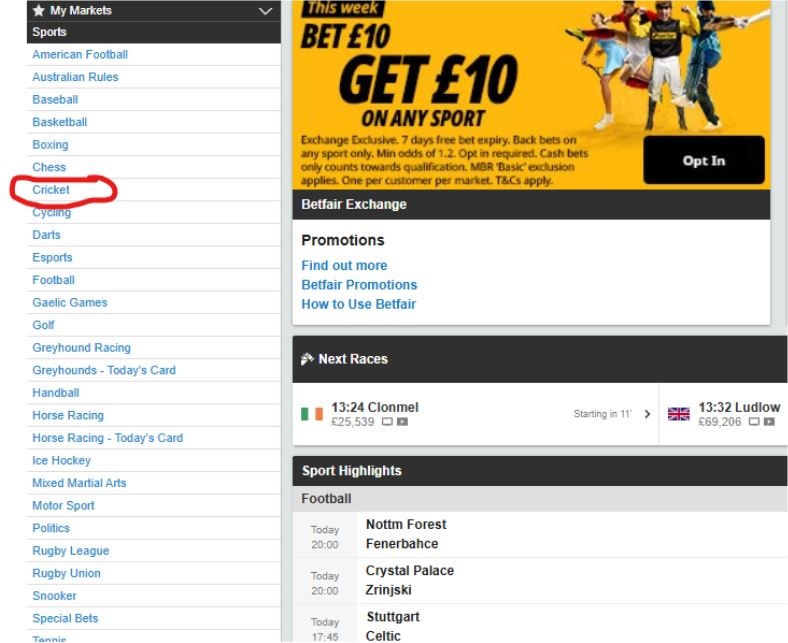
- Choose the sport you want to bet on from the list on the left-hand side of the homepage (in this case, at Betfair). Let’s say you want to bet on cricket.
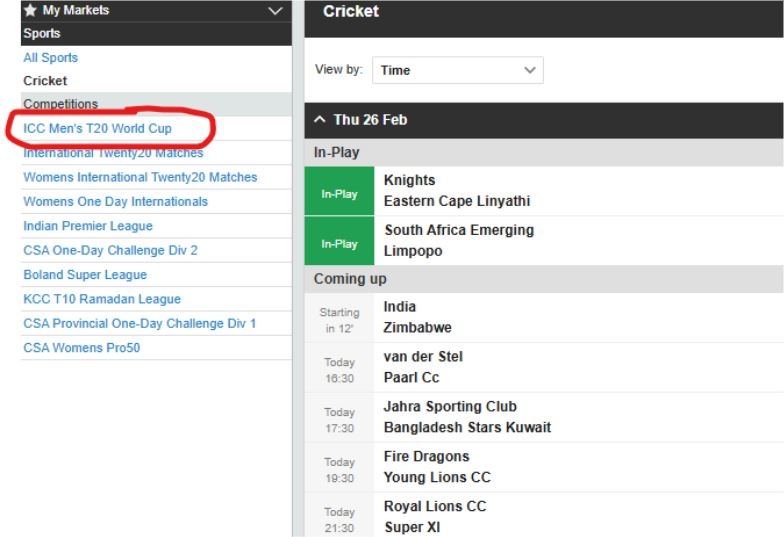
7. Now select the cricket competition you want to bet on (ICC T20 Men’s World Cup).
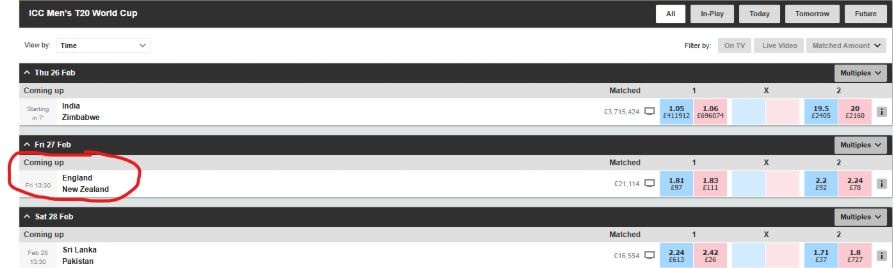
8. Now choose the match you want to bet on: in this case, England v New Zealand.
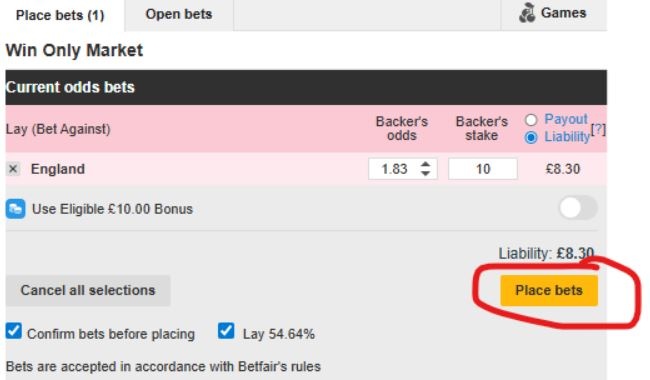
9. You decide you want to lay England, which, in a two-runner market, such as a T20 match, is the same thing as saying you think New Zealand will win. Here England are 1.83 to lay, so click on that. Every time you lay a bet, it’s the odds in pink; every time you back a bet, it’s the odds in blue.

10. Once you’ve decided how much you want to lay the bet for - £10 in this case - on the right-hand side of the market, Betfair will tell you automatically what your liability is: you can see it’s £8.30. So you’ll lose £8.30 if England win, and you’ll win £10 if England don’t win, minus commission.
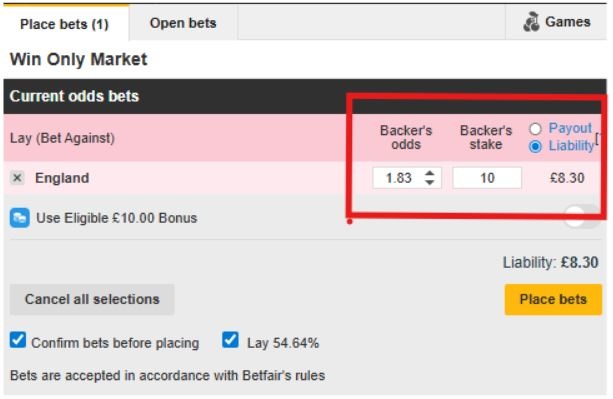
11. Press the ‘Place bets’ button to process the bet.
The "Hidden" Costs: Commission & Premium Charges
Because lay betting sites don’t take risks and therefore don’t win money when you lose your bets, they rely on commission instead. Here’s how it works.
Exchange Commission Models
You only pay commission on winning bets. If your bet loses, there are no costs beyond what you lost on the bet itself.
If you placed 10 bets on a cricket match on the same market and ended up with a winning position, you’d pay commission on your overall win, not on each bet that won.
So let’s say you won £100 at Betfair. Betfair would only return £95 to you because they charge 5% commission, so because 5% of £100 is £50; that’s what they keep as a ‘fee’ by offering you the platform to bet on. A bit like with income tax on your paycheck, the commission is deducted straight away.
If you're betting at Matchbook and the commission was 2%, they’d deduct 2% from each winning bet/overall position.
The Betfair Premium Charge
The Betfair Premium Charge is an additional fee applied to a small percentage of highly profitable customers on the Betfair Exchange. It targets accounts that consistently generate large long-term profits while paying relatively low commission compared to winnings. These accounts could be owned by other bookmakers using Betfair to lay off liability, or professional punters who live off profits generated at Betfair.
If triggered, Betfair ensures a customer pays a minimum percentage of their gross profits (historically around 20%, with higher tiers previously up to 40–60%).
The charge is calculated weekly and only applies if certain profit and activity thresholds are met. Most casual or recreational bettors never encounter it, as it primarily affects high-volume, consistently successful exchange users.
In other words, the Betfair premium charge is something you’re very unlikely to have to pay!
Why Exchanges Are Still Better Value
At betting exchanges, customers don’t have overheads like rent, staff, or tax to pay, so they can afford to offer better odds than fixed-odds bookmakers, who need to insert house edges (between 3% and 12% on average) to each bet they lay to cover those costs, and still remain profitable.
The result is that the odds at exchanges are (almost) always considerably better than at fixed-odds bookmakers. Even after the commission that you pay on winning bets.
Consider this example:
- You bet £100 on Liverpool to beat Leeds at 2.1 at Betfair.
- You bet £100 on Liverpool to beat Leeds at 1.9 with a fixed odds bookmaker called Havefunbet.
Liverpool wins.
- At Betfair, you win £110 from your bet, and 5% commission is deducted from that, leaving you with £104.5.
- At Havefunbet, you win £90. Despite not paying any commission on that bet, it’s still considerably less than what you would have won at Betfair.
Liquidity & Market Depth: Why it Matters for Lay Betting
And now to a crucial part of understanding how lay betting sites work.
What is Liquidity?
Liquidity at a betting exchange refers to the amount of money available to be matched on a market at specific odds. Higher liquidity means larger stakes can be placed without moving the price, faster matching, and an increased likelihood of getting better odds.
Low liquidity can cause delays, partial matches, or price volatility.
Market Depth by Sport
The most popular events in the most popular sports have very high levels of liquidity, of which the Premier League in football, the Cheltenham Festival in racing, and the IPL in cricket are good examples. Less popular events in those sports won’t enjoy the same market depth, and more obscure sports like chess, fencing, or surfing, even less so.
Unmatched Bets & Partial Matching
If you leave a bet up waiting to be matched that doesn’t get matched because a) you requested unrealistic odds, b) there was poor liquidity in the market, it will remain umatched once the market is suspended or the event comes to an end; your money will be returned to you.
Partial matching is where part of the money you wanted to be matched is matched, but not all of it. Let’s say you wanted to lay Black Beauty to win the 3.40 at Aintree for £100 at 2.5. It’s possible that someone came along and backed it at that price for £50, but the remaining £50 wasn’t matched when the race started. £50 of your bet would be live in terms of being dependent on the outcome of the race; the other £50 would be returned to you.
Software & API Integration for Serious Lay Traders
And now it’s time to take things to the next level.
Third-Party Trading Software
Tools like Bet Angel, Geeks Toy, and Gruss Software connect to betting exchanges via API and provide advanced trading interfaces beyond the standard website.
They offer features such as one-click betting, ladder (DOM) views, automation rules, stop-loss settings, greening up, and real-time market data. These software tools allow faster execution, precise stake control, and strategy automation, making them popular with in-play traders and high-volume users seeking efficiency, speed, and improved market analysis.
Time is money, especially when it comes to live trading in horse racing and T20 cricket, and these tools ensure trades are executed as quickly as possible and are free of costly mistakes.
API Stability & Automation
A robust API is vital for automated trading strategies because it enables fast, reliable access to real-time odds, market depth, and order placement without manual interaction. As per above, doing things manually can mean you miss out on executing certain bets or make mistakes in terms of the bets themselves, the odds, or the stake.
Quality APIs reduce latency, support large volumes, and allow algorithmic tools to execute complex strategies like scalping or greening - which means securing a profit on all outcomes - efficiently.
Among exchanges, Betfair is unsurprisingly widely regarded for its comprehensive, well-documented API, while Matchbook also offers solid developer access that supports automation and third-party trading software integration.
But remember that this is ‘next level’ exchange betting and not something for you to worry about when you first start out.
Payout Speeds & Banking at Lay Betting Sites
Let’s look at how long it takes for your withdrawals to be processed at our two featured betting exchanges.
Tested Withdrawal Speeds:
At both Betfair and Matchbook, e-wallets such as Paypal, Skrill and Neteller are much faster when it comes to withdrawals than other methods, sometimes being instant, but mostly taking just a few hours; and very rarely more than a day.
Payment Method Diversity:
We’ve mentioned Paypal, Skrill and Neteller already, while other popular methods at lay betting sites UK include Apple Pay, Google Pay, and Trustly.
Then there are debit cards such as VISA and Mastercard and of course there’s also the old-school bank transfer, but remember that this one will be far slower than all the others.
Also remember that you can no longer use credit cards at any betting sites in the UK, lay betting ones, or otherwise.
Responsible Gambling & Liability Management
When using a betting exchange in the UK, it’s vital to manage your betting responsibly from the outset.
Before registering, check that the lay betting site provides clear responsible gambling tools. Set deposit limits to control daily, weekly or monthly spending.
Use time-outs for short breaks, and ensure self-exclusion options are available if you need a longer pause. UK Gambling Commission-licensed bookmakers must offer these protections. It’s worth emphasising that they're for your own good, so don’t be afraid to use them.
If you need extra support, visit BeGambleAware or GamCare.
Lastly, a word on bankroll management when it comes to lay betting.
Laying a horse at odds of 10.0 may seem like you’re buying money (it means the horse only has a 10% chance of wining) but 10.0 shots win in every sport every day, so get a few of those wrong and your bank could be gone. So never leave yourself in a position where your liability on one bet could wipe out all your funds.
Frequently Asked Questions about Lay Betting
What is the best lay betting site for beginners?
Both Betfair and Matchbook are similar in terms of how easy they are for beginners to get their heads around.
Can I lay a bet on a traditional sportsbook?
No, you can only back bets at traditional sportsbooks. That’s the key difference between them and betting exchanges.
What happens if my lay bet isn't matched?
It’s voided and your money will be returned to you.
Is lay betting legal in the UK?
Yes but remember to only play at sites that hold the UKGC license.
What is the Betfair Premium Charge?
The Betfair Premium Charge is an extra levy imposed on a small number of the most consistently profitable customers using the Betfair Exchange, such as pro punters. It applies to accounts that generate substantial long-term profits while contributing comparatively little in standard commission relative to their overall winnings.
How do I calculate my liability when laying a bet?
To calculate liability when laying a bet, use the formula: Liability = Backer’s Stake × (Decimal Odds − 1). This shows the amount you risk losing if the selection wins.
The people behind this page
